Most manufacturers need an enterprise resource planning platform (ERP) in addition to a modern manufacturing execution system (MES). But you don’t have to implement and push both platforms live at the same time.
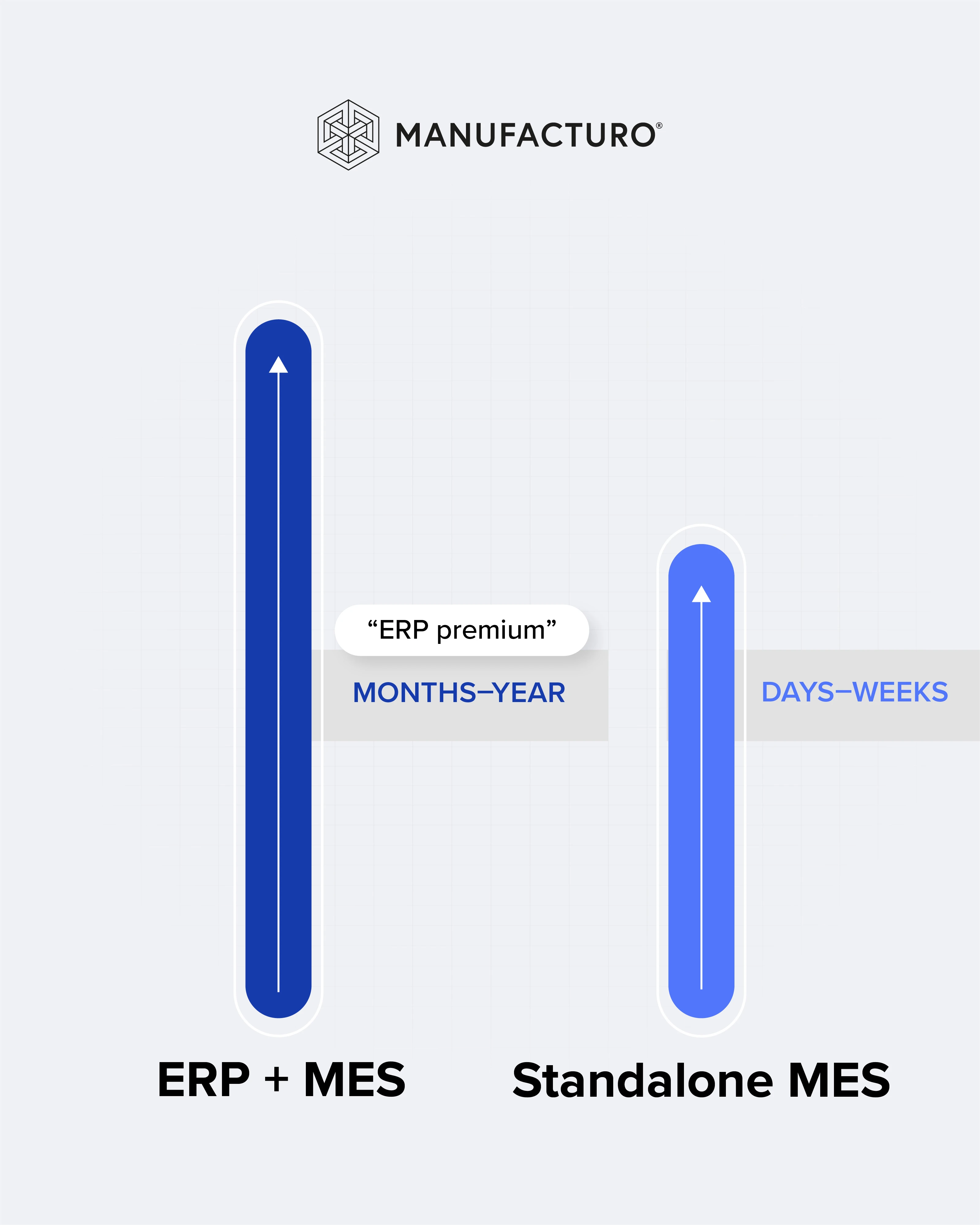
In my 20 years delivering manufacturing applications - including at Apriso and SpaceX - I’ve seen one pattern repeat: tying MES go-live to ERP go-live usually adds a lot of extra time, effort, and cost. I call that the ERP premium.
It’s not because the MES software costs 10x more. It’s because the MES delivery expands to match ERP scale and ERP pace - longer timeline, heavier testing cycles, bigger go-live migration, and more program overhead.
There are pros and cons to doing the go-lives together. I’ve both liked and loathed doing it that way.
Why I liked a combined MES ERP implementation
A combined MES ERP implementation is comprehensive and complicated. A standalone MES rollout can be focused and fast. But when MES is chained to an ERP “big bang,” it turns into a transformation program. There are more stakeholders, more dependencies, more sequencing, and more failure points.
That’s why a $300K MES effort can balloon into a $3M program. The scope grows because the program grows.
So what drives the ERP premium?
What creates the ERP premium
- ERP scale and gravity
Major ERP programs (license and implementation) are often tens of millions, sometimes hundreds of millions. Even if the MES workstream is a smaller part of the overall program, it still inherits the ERP structure - governance, integrated testing cycles, and go-live gates.
Once you're operating inside that structure, timelines stretch and cost follows.
- ERP timelines are longer, and they slip
ERP implementation project duration is usually several months to a year, sometimes longer. A modern manufacturing platform can go live in days or weeks if scope is tight and the team is committed.
The difference isn't just duration. It's volatility. ERP programs slip. And every slip adds more months of project support, re-testing, and cross-team coordination.
We all know it - time is money.
- Integration and testing become a project by itself
From the manufacturing system side, you might only represent 5% to 10% of the end-to-end ERP use cases. But you still get pulled into:
- repeated integration test cycles
- UAT rounds and defect triage across systems
- cross-team coordination and sequencing
Even if MES isn't the root cause, it's part of the chain that moves at ERP speed.
- Go-live migration and hypercare gets heavy
With ERP go-live, migration is rarely "nice to have." It becomes a major workstream:
- months of mapping, cleansing, extraction, and validation
- mock go-lives
- reconciliation and rollback planning
And then hypercare is longer too. Standalone MES implementation might take a few days. With ERP go-live, it can be 2 to 4 weeks (or more), with daily triage and "integration surprises" under real load.
- ERP customization drags everything with it
ERP programs often come with heavy customization. That usually means:
- longer build cycles
- longer regression cycles
- larger testing scope
- more brittle integrations
Modern manufacturing software is increasingly SaaS, designed to be used as-is, upgraded frequently, and built to minimize customization. When ERP customization grows, it adds cost and risk everywhere - including the manufacturing system workstream.
The result
All in all, the duration and complexity of the project are significantly different, and the manufacturing software effort increases by what I call the ERP premium.
Why I didn’t like a combined MES ERP implementation
When MES is tied to ERP go-live, value often comes late, after months of work. And many problems only show up when people start using the system for real.
Also, the “real” go-live often starts after the official go-live, especially for the customer team. That’s when training gaps, process gaps, and bad data show up, and hypercare gets longer than expected.
Does it make sense to go live earlier?
In many cases, yes.
ERP is still needed for most manufacturers, especially bigger companies. The point is not “no ERP.” The point is: you don’t have to wait for ERP go-live to start getting value on the shop floor.
If you go live earlier with a modern MES or manufacturing platform, you can start learning and improving while the ERP program is still running.
- Avoid the big bang
The combined MES ERP implementation and go-live is risky for any business application, especially when the user base is large like manufacturing.
Going live in days or weeks lets you:
- get feedback from real work
- improve fast
- avoid waiting 6-12+ months before users see value
- Things change while you wait
When you wait 6 to 18 months, the factory changes, the product changes, the team changes, and priorities change. Sometimes the original assumptions to make the business case are not valid anymore by the time you go live.
A better approach is: go live quick, use the system, improve continuously. By the time ERP is up, the manufacturing floor may already have gone through rounds of improvements.
- Data gets cleaner before ERP migration
A smooth ERP go-live depends on master data.
If you go live earlier with the manufacturing platform, it helps you clean up master data, validate routings and BOM reality, find inventory issues earlier, and reduce surprises during ERP migration.
And when business applications go sideways, it's often not because the software has critical bugs. It's usually because:
- end user training and readiness is not there
- master data is not ready
- migration becomes hell because data is bad
Ok, but we still need ERP integration later
Yes. Most companies will still integrate MES to ERP. The goal is to make the MES ERP integration simpler.
Draw the line between ERP and manufacturing software
Let ERP focus on financials and planning. Let the manufacturing platform focus on execution, as-built record, and traceability.
Some questions to reduce scope:
- Does ERP really need every detail on the factory floor?
- Do you really need serial-level detail in ERP for finance?
- Do you really need bin-level location in ERP?
The clearer the line, the fewer integration points you need.
If done right, integration scope can be reduced to 10% to 50% of the original “full spec.” That means less integration build time, shorter testing cycles, shorter UAT, smoother go-live, and easier post go-live support.
What I love now
I love standalone or minimum-integration deployments with a tight timeline - weeks or even days.
The pattern is usually: tight timeline so scope stays minimal, use the application as-is (no major customization), minimal migration, no integration or only minimum integration at first, decisions made fast, go live before ERP and start producing value earlier.
To go live in days, it’s not only on the vendor side. It needs a big commitment from the customer team too.

Want to get ERP MES integration right?
If you want to go live fast on the floor and still keep a clean long-term ERP integration, talk to us. Our integration abilities are best in class and our service team operates with customers as a value-add partnership.